


.webp)
A well-structured nurse practitioner onboarding plan is one of the highest-return investments a healthcare organization can make, and most practices are not making it. A standardized onboarding program for advanced practice providers produced an 80% increase in positive responses when participants were asked whether they intended to stay in their role for at least one year, according to a 2024 study published in the Journal for Nurse Practitioners. The first 90 days determine whether a new nurse practitioner builds the clinical confidence, organizational clarity, and role security needed to stay, and a milestone-based onboarding plan is what makes that window productive rather than expensive.
Why the First 90 Days Determine Whether the NP Onboarding Investment Holds
The hire is made. Credentialing is complete. The new nurse practitioner starts on Monday. What happens in the next 90 days determines whether the practice gets a return on that investment or restarts the search within the year.
By 30 days, 70% of new clinical hires have made their stay-or-leave decision. What new nurse practitioners are assessing in those first weeks is whether the organization understands the role they were hired to fill, whether the support structure matches what the offer implied, and whether the anxiety and role ambiguity that almost every NP experiences in a first position is being acknowledged or ignored.
Recent research into the nurse practitioner onboarding experience has identified consistent patterns across the transition to practice.
A qualitative study examining NP perspectives through thirteen semistructured interviews and inductive coding methodology surfaced nine thematic concepts that shape whether a new NP's transition succeeds: creating comfort, building self-confidence, clarifying expectations, open communication, promoting mentorship, providing clear organizational support, continuous learning, tailoring ramp-up to the individual, and improving competence over time. These themes appear across new graduate and experienced NP onboarding alike.
A 2025 study from the American Organization for Nursing Leadership examining more than 75,000 nurses found that managers who conducted check-ins at the 30 or 45-day mark saw a six-percentage-point increase in first-year retention. For a practice that replaced its last NP at 1.5 to 2 times salary, that number carries real financial weight.
The onboarding plan that follows is built around these findings. Milestone-based, measurable, and designed to address the psychosocial factors and structural components that determine whether a new nurse practitioner reaches full clinical productivity or becomes another costly turnover statistic before the end of year one.
The Nurse Practitioner Onboarding Checklist, Milestone by Milestone
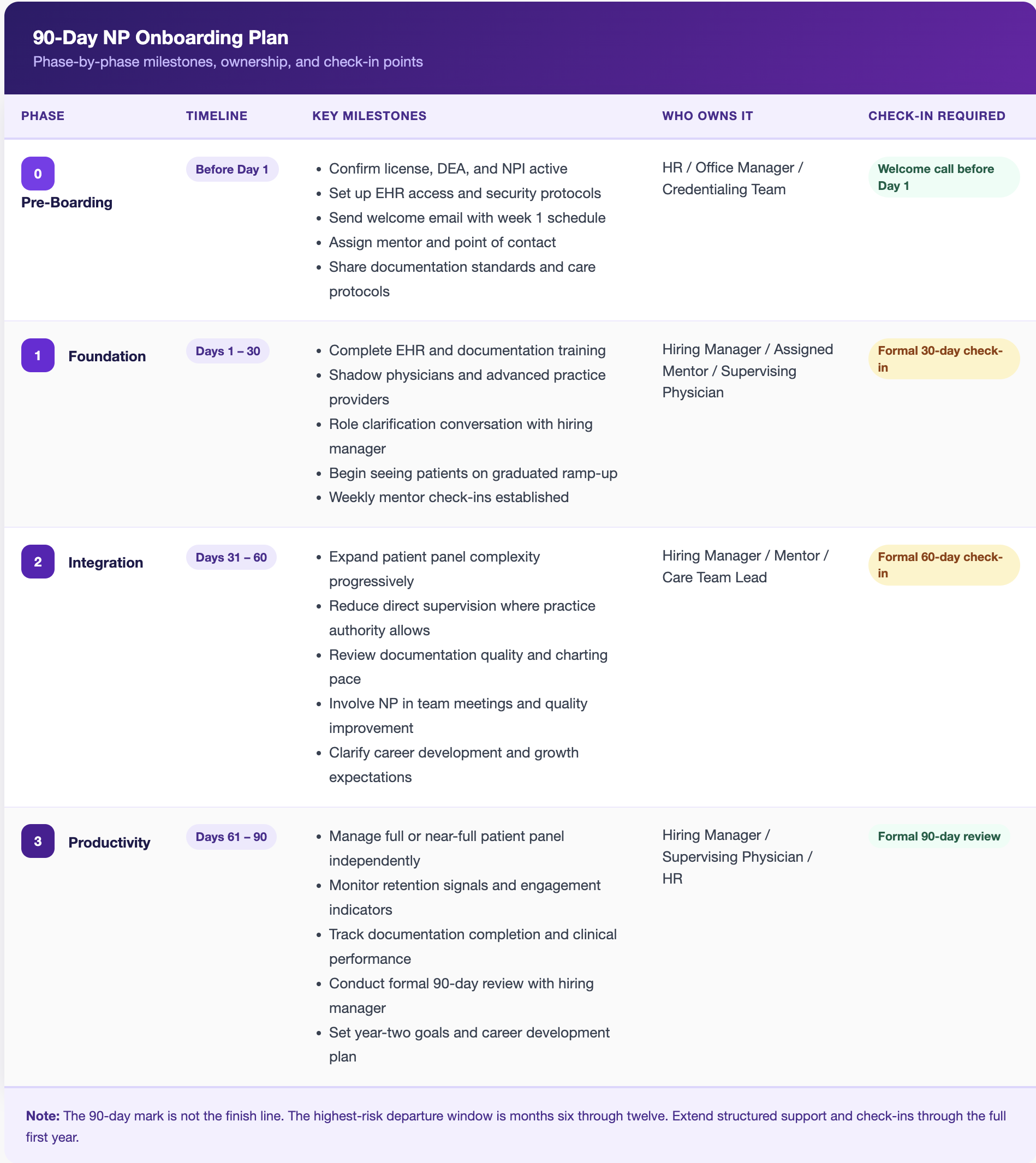
Orientation is an event. Onboarding is the arc that follows it. The plan below covers four phases, each with specific milestones, check-in points, and the organizational support structures that research consistently identifies as drivers of successful transition to practice for new nurse practitioners.
Pre-Boarding: What to Complete Before Day One of NP Onboarding
The pre-boarding phase begins the moment the offer is accepted and ends the morning the new NP walks in. What gets done in this window determines whether day one feels like an organized welcome or a scramble that sets the wrong tone for everything that follows.
Credentialing and access:
- Confirm state license, DEA registration, and NPI number are active and on file
- Submit hospital privileging application if applicable and initiate payer enrollment in parallel
- Establish EHR access and complete any required security protocols before the first day so the new NP can document from day one without waiting on IT
Logistics and communication:
- Send a pre-boarding welcome that includes the schedule for the first week, who to ask for, where to park, what to wear, and what to expect on day one
- Assign a designated point of contact, a physician, office manager, or experienced NP who the new hire can reach before day one with questions
- Confirm patient scheduling expectations, specifically when the new NP will begin seeing patients independently and what the ramp-up schedule looks like for the first 30 days
Culture and context:
- Share the practice's documentation standards, care protocols, and any EMR workflows specific to this setting before the first day so the new NP arrives with context rather than encountering everything cold
- Introduce the new hire to the team via email or an online portal before day one so names and faces are not entirely unfamiliar on arrival
A new nurse practitioner who arrives on day one knowing what the first week looks like, who their mentor is, and where to find the information they need starts from a position of clarity rather than anxiety. That distinction shapes the entire first 30 days.
Days 1 to 30: The Foundation Stage of Onboarding Nurse Practitioners
The first 30 days are where role ambiguity either gets addressed or calcifies into a retention risk. New nurse practitioners in a first primary care position or any new clinical setting are simultaneously learning the EMR, the patient population, the team dynamics, and the unwritten expectations of the practice. The foundation stage is about reducing that cognitive load without eliminating the learning curve.
Week 1 priorities:
- Complete EMR and electronic health record training with hands-on support rather than self-directed modules alone, as new NPs in primary care settings consistently report EHR access and documentation workflow as the steepest early learning curve
- Shadow existing providers, including physicians and any physician assistants or other advanced practice providers on the team, to observe patient flow, documentation pace, and how clinical decisions get made in this specific setting before the NP is expected to replicate them independently
- Conduct a formal role clarification conversation covering scope of practice, patient scheduling expectations, referral protocols, prescribing authority conditions, and what the ramp-up to a full patient panel looks like so expectations are explicit rather than assumed
Weeks 2 through 4:
- Begin seeing patients with graduated independence, starting with lower-complexity cases and expanding as the NP demonstrates comfort with the EMR, the patient population, and the documentation standards the practice uses
- Assign a formal mentor, a physician or experienced NP who meets with the new hire at least weekly during the first month to address clinical questions, provide feedback on documentation, and offer the kind of open communication that research consistently identifies as a driver of successful transition to practice
- Conduct a formal 30-day check-in with the hiring manager that covers how the NP feels about the role, what support they need that they are not currently receiving, and whether their expectations of the position match the reality they are experiencing
A 2025 study from the American Organization for Nursing Leadership found that managers who conducted check-ins at the 30 or 45-day mark saw a six-percentage-point increase in first-year retention. The 30-day check-in is not a performance review. It is the earliest opportunity to identify the friction points that, left unaddressed, become the reasons a new NP starts a job search by month six.
Days 31 to 60: Growing Independence in the Nurse Practitioner Onboarding Plan
By day 31, the new nurse practitioner has a working knowledge of the EMR, has met the care team, and has begun seeing patients. The second phase of onboarding is where the transition from supported to independent practice happens, and where psychosocial factors including self-confidence, belonging, and clarity about long-term role expectations become the primary drivers of retention risk.
Clinical milestones:
- Expand patient panel complexity progressively, adding chronic condition management, preventive care visits, and higher-acuity cases as the NP demonstrates competence and confidence with the patient population
- Reduce direct supervision requirements where practice authority and state law allow, giving the NP increasing autonomy in clinical decision making while maintaining open channels for consultation with the collaborating physician or senior provider
- Review documentation quality and charting pace with the mentor or supervising provider, addressing any patterns that suggest the NP is falling behind on charting or struggling with specific documentation workflows before those patterns become entrenched
Organizational integration:
- Involve the new NP in team meetings, case discussions, and any quality improvement initiatives the practice is running, creating opportunities for the NP to contribute beyond direct patient care and build relationships across the care team
- Clarify career development expectations explicitly, including whether the practice supports continuing education, specialty certification, or advancement into leadership roles, as new nurses and advanced practice providers consistently cite lack of growth visibility as a driver of early departure
- Conduct a formal 60-day check-in that assesses clinical confidence, team integration, and whether any unresolved role ambiguity from the first 30 days has been addressed or has persisted into the second month
Days 61 to 90: Full Productivity and the Retention Signals Every NP Onboarding Plan Must Catch
The final phase of the 90-day nurse practitioner onboarding plan is where the practice begins to see the return on its onboarding investment, and where the signals that predict whether the NP will stay past year one become visible if the organization is paying attention.
Clinical expectations:
- The new NP should be managing a full or near-full patient panel independently by day 90, with documentation completed within the timeframes the practice expects and clinical decision making that reflects the patient population and scope of the role
- Higher clinical productivity in this phase depends on how well the first 60 days addressed the structural components of the onboarding plan, specifically EMR fluency, role clarity, and the psychological safety to ask clinical questions without experiencing the anxiety and role ambiguity that new NPs consistently report when those foundations were not established early
Retention signals to watch:
- Engagement in team activities, willingness to take on additional patient complexity, and proactive communication with the mentor or supervising provider are positive indicators that the NP is integrating successfully
- Withdrawal from team interactions, persistent documentation delays, reluctance to take on complex cases, or comments about unmet expectations are early signals that the onboarding plan has gaps that have not been closed and that the NP may be weighing their options
The 90-day conversation:
- Conduct a formal 90-day review that covers clinical performance, role satisfaction, organizational support, career goals within the practice, and any adjustments to the patient scheduling or ramp-up plan that would better position the NP for year two
- A standardized onboarding program for advanced practice providers produced an 80% increase in positive responses when participants were asked whether they intended to stay in their role for at least one year. The 90-day review is where that intention gets named, reinforced, and anchored to a specific plan for what the next year looks like.
The 90-day mark is not the finish line for NP onboarding. The highest-risk window for departure is months six through twelve, well after orientation wraps, and support needs to extend through the first year. What day 90 represents is the point at which the foundation is either solid enough to build on or fragile enough to collapse under the weight of the second year's expectations
What the NP Onboarding Plan Needs to Measure
A nurse practitioner onboarding plan without measurement is a schedule. Adding milestones and check-ins to the calendar is the minimum. Knowing whether those milestones are producing the outcomes the practice needs requires tracking the right indicators at the right intervals, and acting on what they reveal before the 90-day window closes.
The Metrics That Tell You Whether Onboarding Nurses Is Working Before It Is Too Late
The metrics that matter in NP onboarding fall into three categories: clinical productivity, retention signals, and onboarding experience. Each category requires a different data source and a different response when the numbers are not where they should be.
Clinical productivity metrics:
- Time to full patient panel measures how quickly the new NP moves from a reduced or supervised caseload to the patient scheduling volume the practice needs to justify the hire financially. A well-structured onboarding process with clear ramp-up expectations and adequate EMR support produces faster time to full productivity than one that leaves new hires to adjust without structured guidance
- Documentation completion rates within expected timeframes reveal whether the NP has achieved EHR fluency or is still struggling with electronic health record workflows that are consuming clinical time and creating downstream scheduling problems for the practice
- Patient outcome indicators including quality metrics, patient satisfaction scores, and any flags raised by the supervising physician or collaborating provider give the practice an early signal of whether clinical performance is on track or requires additional support before poor clinical outcomes become a pattern
Retention signal metrics:
- Ninety and 180-day retention rates for new NP hires, tracked against the practice's historical baseline, indicate whether the onboarding program is producing different outcomes than whatever the practice was doing before
- Engagement indicators including participation in team meetings, proactivity in seeking mentorship, and willingness to take on additional clinical complexity are observable signals that do not require a formal survey to track
- Absenteeism patterns in the first 90 days, particularly unexplained absences or frequent use of sick time, are early behavioral signals that a new NP is experiencing stress, role ambiguity, or disengagement that a check-in conversation may surface before it becomes a departure
Onboarding experience metrics:
- Pulse surveys at 30, 60, and 90 days that ask the new NP directly about role clarity, organizational support, mentor quality, and whether their onboarding experience is meeting their needs give the practice actionable data while there is still time to respond to it
- Organizations with effective onboarding achieve 82% higher retention and 70% faster time-to-productivity according to Brandon Hall Group research, and the difference between those outcomes and the baseline almost always traces back to whether the practice was measuring onboarding experience or assuming it was adequate
Tracking these metrics requires someone to own them. In healthcare organizations with human resources infrastructure, that ownership sits with HR. In independent practices and smaller clinical settings, it sits with the hiring manager or supervising physician. The method matters less than the commitment to act on what the data reveals before the six to twelve month window where most early NP departures cluster.
The Investment Is Already Made. Protect It.
Finding, recruiting, credentialing, and placing a nurse practitioner takes months and costs significantly more than most practices account for upfront. By the time a new NP walks in on day one, the investment is already made. What the first 90 days determine is whether that investment produces a clinician who stays and grows, or one who leaves and triggers the same process again at full cost.
The research is consistent on what drives early NP departure. Anxiety and role ambiguity that go unaddressed in the first 30 days. Lack of clear organizational support during the transition to practice. Mentorship that exists on paper but not in practice. A ramp-up plan that was never communicated explicitly. A 90-day review that never happened because the practice assumed everything was fine.
None of those failures require significant resources to fix. They require structure, communication, and the discipline to conduct the check-ins that research shows move first-year retention by meaningful percentages. A six-percentage-point increase in retention from a single 30-day check-in is not a small return on a 30-minute conversation.
Nurses who receive structured 90-day onboarding are 69% more likely to stay three years. For a practice managing the cost of advanced practice provider turnover, that figure puts the value of an onboarding plan in terms that belong in a budget conversation, not just an HR process document.
NPHire delivers five specialty-matched, interview-ready nurse practitioners within 30 days. The onboarding plan is what protects that placement after the hire is made. For practices that want both, the conversation starts with a 30-minute hiring call.
Frequently Asked Questions
1. Why do so many NP hires leave within the first year?
Most early NP departures trace back to the onboarding period rather than to compensation or clinical fit. Research into NP perspectives on transition to practice consistently identifies anxiety and role ambiguity, lack of clear organizational support, inadequate mentorship, and unmet expectations about the role as the primary drivers of first-year departure. A qualitative study examining new NP onboarding experiences through thirteen semistructured interviews found nine thematic concepts that determine whether the transition to practice succeeds, and most of them are organizational failures rather than candidate failures. The new NP who leaves in month eight was often signaling the problem in month two, and a structured onboarding plan with regular check-ins is what catches those signals early enough to act on them.
2. What should a nurse practitioner onboarding checklist cover in the first 30 days?
A nurse practitioner onboarding checklist for the first 30 days should cover EHR access and electronic health record training, role clarification including scope of practice and patient scheduling expectations, formal mentor assignment with at least weekly contact, a graduated patient ramp-up plan that builds complexity progressively rather than placing the new NP in a full panel immediately, and a formal 30-day check-in with the hiring manager that surfaces unresolved questions about the role before they become retention risks. A 2025 study from the American Organization for Nursing Leadership found that managers who conducted check-ins at the 30 or 45-day mark saw a six-percentage-point increase in first-year retention, making the 30-day conversation one of the highest-return activities in the entire onboarding process.
3. How is NP onboarding different from RN onboarding?
Nurse practitioner onboarding involves a different set of clinical, regulatory, and organizational transitions than RN onboarding. New NPs are moving into an autonomous clinical role that requires independent decision making, prescribing authority, and often a shift in professional identity from a supervised to an unsupervised clinician. The credentialing process, DEA registration, and payer enrollment stages that precede NP onboarding have no direct equivalent in RN onboarding. The psychosocial factors are also distinct. Research on new graduate and experienced NPs entering a first primary care position consistently identifies self-confidence building, role ambiguity resolution, and clarity about organizational support as central onboarding needs that differ from those of new RNs entering a structured shift-based role.
4. What does a structured 90-day nurse practitioner onboarding plan look like?
A structured 90-day nurse practitioner onboarding plan covers four phases. Pre-boarding completes credentialing, EHR access, and logistics before day one. Days one through 30 focus on EMR training, role clarification, shadow experience, graduated patient ramp-up, and a formal 30-day check-in. Days 31 through 60 expand clinical independence, integrate the NP into team activities and quality improvement initiatives, and conduct a 60-day check-in that assesses integration and addresses any unresolved role ambiguity. Days 61 through 90 move the NP toward a full patient panel, track retention signals including engagement and documentation pace, and conclude with a formal 90-day review that covers clinical performance, role satisfaction, and career goals for year two. A standardized onboarding program for advanced practice providers following this kind of structure produced an 80% increase in positive intent-to-stay responses according to a 2024 study in the Journal for Nurse Practitioners.
5. How do check-ins during onboarding nurse practitioners affect retention?
Check-ins during nurse practitioner onboarding affect retention by surfacing the friction points that new NPs experience but rarely raise without a structured invitation to do so. Role ambiguity, unmet expectations, inadequate mentorship support, and documentation struggles are the issues most likely to drive a new NP toward a job search, and they are also the issues most likely to go unaddressed when the practice assumes the onboarding is going well because the NP has not complained. A 2025 study from the American Organization for Nursing Leadership examining more than 75,000 nurses found that managers who conducted check-ins at the 30 or 45-day mark saw a six-percentage-point increase in first-year retention. Regular check-ins also create the open communication environment that new NPs in transition to practice research consistently identify as a driver of successful onboarding outcomes.
6. What metrics should employers track during NP onboarding?
Employers should track three categories of metrics during nurse practitioner onboarding. Clinical productivity metrics include time to full patient panel, documentation completion rates within expected timeframes, and any clinical performance flags raised by the supervising provider. Retention signal metrics include 90 and 180-day retention rates, engagement indicators like participation in team activities and proactive mentorship seeking, and early absenteeism patterns that may signal stress or disengagement. Onboarding experience metrics include pulse survey results at 30, 60, and 90 days that ask the new NP directly about role clarity, organizational support, and whether the onboarding plan is meeting their needs. Organizations with effective onboarding achieve 82% higher retention and 70% faster time-to-productivity according to Brandon Hall Group research, and those outcomes are only achievable when the practice is measuring the onboarding experience rather than assuming it is adequate.
7. What is the ROI of a structured nurse practitioner onboarding program?
The ROI of a structured nurse practitioner onboarding program is most clearly expressed in reduced turnover cost and faster time to full clinical productivity. Replacing an NP costs 1.5 to 2 times their annual salary. Nurses who receive structured 90-day onboarding are 69% more likely to stay three years, which means the difference between a structured and an unstructured onboarding plan is measurable in the frequency of that replacement cost across a practice's NP workforce over time. One hospital's onboarding restructure reduced new-nurse turnover by 47% and cut turnover costs by roughly $186,102. A 2025 study documented a mentorship program that cost approximately $4,000 to implement but resulted in avoiding approximately $480,000 in turnover costs when all mentees remained employed for a minimum of three months past the program. The investment required to build a structured 90-day NP onboarding plan is small relative to the cost it averts.
8. How does a poor NP onboarding experience affect long-term retention?
A poor nurse practitioner onboarding experience produces retention risk that extends well beyond the first 90 days. The highest-risk window for NP departure is months six through twelve, after orientation has ended and the initial adjustment period has passed, when the gap between what the NP expected from the role and what they are actually experiencing becomes too wide to rationalize. New NPs who experienced anxiety and role ambiguity that went unaddressed in the first 30 days, inadequate mentorship during the transition to practice, or a ramp-up plan that left them feeling unsupported are the ones most likely to begin a job search in that six to twelve month window. A positive onboarding experience does not guarantee retention past year one, but research is consistent that it significantly improves the probability that a new NP will still be in the role when the practice needs them to be.


.webp)