

Urgent care NP staffing at volume and urgent care NP staffing for fit are not opposing strategies, but most multi-site operators run them that way, and the turnover bill reflects it. The clinical directors and hiring managers who consistently staff urgent care facilities with nurse practitioners who stay have not found a way to slow down the hiring process. They have built fit criteria into the parts of the process that run before the first interview, so speed and quality move together rather than trading off against each other.
Why Urgent Care NP Staffing Is a Different Healthcare Staffing Problem
Urgent care runs on throughput. Patients walk in without appointments, volume spikes unpredictably, and a facility that cannot staff its clinical seats does not just lose revenue. It closes rooms, redirects patients, and puts the remaining care team under a load that accelerates the next departure.
That operational reality creates a hiring pressure that most healthcare staffing approaches were not designed for. A single-site primary care practice hiring one NP per year can afford a 90-day curated search. A multi-site urgent care operator staffing across a dozen facilities cannot run the same process at scale without the search timeline becoming its own operational problem.
The volume requirement is real. What makes urgent care NP staffing genuinely difficult is that volume hiring in healthcare consistently produces a specific outcome: candidates who meet the credential threshold, clear the screening process, and leave within a year because the work environment, patient population, or schedule structure was not what they signed up for. The replacement cost at 1.5 to 2 times annual salary applies to every one of those exits, and it compounds across facilities.
Urgent care nurse practitioners operate in a distinct clinical environment. They manage high-acuity walk-in patients across a broad range of presenting conditions, make rapid independent clinical decisions without the safety net of a scheduled appointment structure, handle radiology interpretation, work rotating or extended hour shifts, and do all of it in a care setting where communication skills and composure under pressure matter as much as clinical knowledge.
A nurse practitioner who thrives in a primary care panel model is not automatically a strong fit for urgent care, and a screening process that does not evaluate for those specific competencies produces placements that look right on paper and wrong within 90 days.
Where Urgent Care Nurse Practitioner Hiring Breaks Down
The breakdown points in urgent care NP staffing are consistent across multi-site operators, independent facilities, and healthcare staffing agency relationships alike. They show up at different stages of the process, but they share a common cause: the hiring process was designed for a different type of search.
The Speed Trap: When Filling Urgent Care NP Seats Fast Produces Seats That Empty Faster
Speed in urgent care NP staffing is not optional. An open seat in a high-volume facility costs patient access, strains the remaining care team, and generates the overtime and coverage premiums that make vacancy cost a real operational number. The pressure to fill fast is legitimate.
The speed trap is what happens when that pressure compresses the screening process rather than the search timeline. A hiring manager who needs an urgent care NP in two weeks and receives 80 applications from a general job board faces a choice: screen thoroughly and miss the timeline, or screen quickly and accept a candidate whose fit for the specific demands of urgent care was never properly evaluated.
- Urgent care NP roles require clinical independence, comfort with high patient volume, the ability to manage acute presentations without scheduled follow-up continuity, and a work schedule tolerance that not every qualified nurse practitioner shares. A screening process compressed under timeline pressure consistently misses those variables because they are not on the resume
- Healthcare staffing agencies filling urgent care NP positions on a direct hire basis frequently optimize for credential verification and availability rather than for the specific clinical environment and patient population the role involves, producing placements that meet the qualification threshold without assessing the fit variables that determine whether the NP stays past the first contract period
- Multi-site urgent care operators who fill seats fast without fit criteria built into the pre-screening stage consistently report higher 90-day turnover than those who run a faster process with better pre-screening, because the speed advantage of a compressed screen disappears the moment the replacement search begins
- The care team absorbs the cost of a poor urgent care NP fit in ways that compound beyond the direct replacement expense. Physicians and allied health professionals covering for an NP who is underperforming, disengaged, or actively planning to leave carry a clinical and morale burden that affects the retention of staff who were never part of the vacancy problem
- Hiring managers at urgent care facilities who have experienced repeated 90-day turnover often respond by lowering their fit expectations on the next search, creating a cycle where speed pressure and poor fit reinforce each other across successive hiring rounds
Speed is the right goal in urgent care NP staffing. Compressing the screen to achieve it is where the speed trap closes.
The Volume Problem: Why Scaling NP Staffing Candidate Flow Does Not Scale Candidate Quality
Multi-site urgent care operators need more candidates than a single-site practice. That need leads most operators toward sourcing channels built for volume, which is where the second breakdown point appears. General job boards, broad healthcare staffing agency partnerships, and high-application-volume job descriptions reach large audiences of healthcare professionals. They do not reach specialty-matched urgent care NP candidates at a rate that justifies the screening burden they generate.
- A job description optimized for application volume rather than candidate qualification produces a candidate pool that requires significant screening time to reduce to a usable shortlist, and the qualified urgent care NP candidates in that pool are competing against offers from employers who reached them directly rather than waiting for them to apply
- Nurse practitioner recruiting firms and staffing agencies that specialize in advanced practice placement build candidate networks specifically around NP credentials, clinical experience, and specialty background, which produces a different starting pool than a general healthcare staffing agency posting the same role to a broad job board audience
- Volume sourcing for urgent care NP roles in high-demand markets generates competition from every other urgent care facility, hospital system, and multi-site operator posting simultaneously, which means the qualified candidates in the applicant pool are evaluating multiple opportunities and accepting offers on timelines that broad sourcing strategies cannot match
- Allied health professionals and physician assistants who apply to urgent care NP postings add screening volume without adding qualified candidates, and the staff time required to process those applications at scale across multiple facilities creates an administrative burden that falls on hiring managers whose primary responsibility is clinical operations
- The best candidates for urgent care NP roles are often currently employed and not actively searching general job boards, which means the sourcing strategy that produces the highest application volume is structurally the worst at reaching the candidates most likely to be a strong fit for the role
Scaling candidate flow without scaling candidate quality produces more work for the same outcome, and in urgent care where hiring managers are already carrying clinical and operational responsibilities, that additional screening burden consistently delays the process rather than accelerating it.
The Fit Gap: What Urgent Care NP Roles Actually Require That Generic Staffing for Healthcare Misses
The fit variables that determine whether an urgent care NP placement holds are not captured in a credential check or a standard job description review. They are clinical, behavioral, and logistical, and they require specific pre-screening questions that most generic healthcare staffing processes were not built to ask.
- Urgent care NP roles require comfort with diagnostic uncertainty and the ability to make rapid clinical decisions on acute presentations without the patient history depth that scheduled primary care appointments provide. A nurse practitioner whose clinical training and prior experience is weighted toward chronic condition management and longitudinal patient relationships faces a different day in urgent care than their qualifications alone predict
- Schedule tolerance is a fit variable that urgent care NP sourcing consistently underweights. Extended hour shifts, rotating weekends, holiday coverage requirements, and the absence of a predictable weekly schedule are features of urgent care work schedules that not every qualified NP is willing to sustain. A candidate who accepts a position without fully understanding the schedule reality frequently becomes a departure within the first quarter
- Patient population breadth in urgent care spans pediatrics to geriatrics, minor injuries to high-acuity presentations requiring emergency escalation, and routine illness to complex multi-system complaints requiring rapid triage and referral decisions. Nurse practitioners who have specialized in a narrow patient population face an adjustment that affects their confidence, their pace, and their job satisfaction in ways that a credential screen does not surface
- Communication skills and composure under patient load pressure are clinical fit variables that matter as much in urgent care as board certification. A nurse practitioner who struggles with the communication demands of a high-volume walk-in environment, where patients have not scheduled their visit and often arrive frustrated, creates patient safety and satisfaction risks that compound across a busy shift
- Radiology interpretation, point-of-care testing, and the procedural scope that urgent care NP roles frequently require are clinical competencies that vary significantly across nurse practitioners with equivalent credentials and years of experience, and a pre-screening process that does not evaluate for them produces placements where the NP’s actual procedural confidence does not match the role’s clinical demands from day one
The fit gap is a screening problem, and it occurs before the first interview. At the pre-screening stage, the right questions produce the information that determines whether the placement holds. That is the most directly addressable breakdown point in urgent care NP staffing, and it is the one most generic healthcare staffing processes skip entirely.
How to Hire Fast and at Scale Without Sacrificing Nurse Practitioner Staffing Fit
The operators who consistently fill urgent care NP seats without the 90-day turnover cycle have made one structural change to their hiring process. They moved fit evaluation upstream, into the sourcing and pre-screening stages, so that by the time a candidate reaches the hiring manager’s calendar the credential check, the schedule tolerance conversation, the clinical scope assessment, and the availability confirmation have already happened.
That change does not slow the process. It compresses the time between a qualified, fit-matched candidate entering the pipeline and an offer being extended. The stages that used to happen during and after interviews happen before them, and the interviews themselves become faster because the pre-screening has already eliminated the candidates who would have failed at that stage anyway.
Five things change when fit gets built into the urgent care NP staffing process from the start.
Sourcing shifts from broad to targeted.
General job boards reach everyone. Urgent care NP staffing that produces qualified candidates consistently uses sourcing channels built around nurse practitioner credentials and clinical specialty.
Nurse practitioner recruiting firms and staffing agencies that specialize in advanced practice placement start each search from a candidate network filtered by NP certification, clinical background, and specialty experience rather than building that filter manually from a broad applicant pool. For multi-site operators, that sourcing shift means fewer total applications and a higher percentage of qualified candidates in the pool, which reduces screening time per hire across every facility simultaneously.
Pre-screening covers fit variables, not just credentials.
A credential check confirms the NP can legally practice. A fit-oriented pre-screen confirms the NP will actually work in this environment. The questions that separate the two cover schedule tolerance, prior urgent care or acute care experience, comfort with the patient population breadth the facility sees, procedural competencies including radiology and point-of-care testing, and the candidate’s honest assessment of what they are looking for in their next position.
Those conversations take 15 to 20 minutes per candidate and eliminate the placements that would have failed at the 90-day mark before the offer is ever extended.
The job description communicates the reality of the role.
Urgent care NP job descriptions that list credentials and responsibilities without communicating the work schedule structure, patient volume expectations, shift requirements, and clinical scope attract candidates who apply to the credential match and disengage when the actual role becomes clear.
A job description that accurately describes a rotating weekend schedule, extended hour shifts, and a high-volume walk-in patient population self-selects for candidates whose expectations match the reality before the first screening call happens.
Interview processes are standardized, not improvised.
Urgent care facilities that run different interview processes at different sites produce inconsistent hiring outcomes across the network.
Standardized interview questions, defined evaluation criteria, and a consistent decision timeline give hiring managers at every facility the same framework for assessing clinical fit, communication skills, and composure under pressure, which produces comparable candidate quality across the organization rather than outcomes that vary by site and by hiring manager.
The offer reflects what urgent care NPs actually evaluate.
Compensation, schedule flexibility, benefits, and career advancement opportunities all factor into an urgent care NP’s offer decision.
Pay transparency in job descriptions, clearly communicated benefits including malpractice coverage and healthcare benefits, and defined expectations around shift structure and scheduling reduce offer-stage surprises that produce candidate withdrawals after a multi-week hiring process.
Hire for the Role, Not Just the Credential
Urgent care NP staffing at volume is a real operational requirement, and pretending otherwise does not serve the multi-site operators and clinical directors who need to keep facilities staffed across unpredictable patient demand. The throughput pressure is legitimate. What compounds it is a hiring process that generates activity without producing progress, cycling through candidates, offers, and replacements at a pace that keeps the seats technically filled and the turnover cost quietly compounding.
Breaking that cycle comes down to where fit evaluation happens in the process. When it happens upstream, in sourcing and pre-screening, the candidates who reach the interview stage are already qualified, already matched to the clinical and scheduling demands of the role, and already informed about what working there actually involves. The interview becomes a confirmation rather than a discovery, and the offer stage stops producing withdrawals from candidates who did not understand what they were accepting.
Each of those changes is an upstream decision. None of them require a longer hiring timeline. Together they produce a process where time from first contact to accepted offer compresses rather than extends, and where 90-day exits stop being a recurring cost the organization budgets around.
Multi-site urgent care operators often have strong hiring managers and not enough hours to source for every facility at once. NPHire fills that gap with five interview-ready nurse practitioners matched to the specialty and location of the role within 30 days. The practice pays only when someone is hired, and if that NP leaves within six months, the replacement is free. Most operators start with a 30-minute hiring call to walk through what each site needs.
Frequently Asked Questions
1. What makes urgent care NP staffing different from other nurse practitioner staffing?
Urgent care runs on walk-in volume, which means demand shifts by the hour and a single open seat can close rooms across a shift. Urgent care nurse practitioners manage a wide range of acute presentations, often handle radiology review and point-of-care testing, and make fast independent decisions without scheduled follow-up. Those demands call for a narrower fit profile than most primary care or specialty roles, and the hiring process has to screen for it.
2. How do you screen for fit when hiring urgent care NPs at volume?
Move the fit questions into the pre-screening call rather than saving them for the interview. A 15 to 20 minute conversation covering schedule tolerance, prior urgent care or emergency experience, procedural comfort, and what the candidate wants from their next position filters out mismatches early. Hiring managers then spend their interview time on candidates who already meet the practical demands of the role.
3. What clinical competencies matter most when hiring urgent care nurse practitioners?
The core competencies are rapid triage, comfort with diagnostic uncertainty, and the judgment to know when a patient needs emergency escalation. Many urgent care roles also require confidence with radiology interpretation, minor procedures, and point-of-care testing. Communication skills matter just as much, since patients arrive unscheduled and often frustrated, and the NP sets the tone of the visit within the first few minutes.
4. How do you reduce NP turnover at urgent care without slowing the healthcare staffing process?
Most early urgent care exits trace back to expectations that were never set during hiring, especially around shifts, weekends, and patient volume. Writing those realities into the job description and confirming them in the pre-screen lets candidates opt out before an offer is made. A structured onboarding plan with regular check-ins then helps new hires settle into the pace before frustration builds.
5. What does a fast urgent care NP hiring process actually look like?
A fast process runs from pre-screen to offer in about one week. Qualified candidates get a short screening call, a single clinical interview with the medical director or lead physician, and a site visit or shift observation, with a decision within 24 hours of each stage. Standardizing these steps across every facility keeps the timeline consistent no matter which site is hiring.
6. How many NPs does a multi-site urgent care operation typically need to hire per year?
The number depends on site count, hours of operation, seasonal volume swings, and historical turnover. A practical way to estimate it is to multiply the total budgeted NP FTEs across all sites by your annual turnover rate, then add any planned expansion. Tracking budgeted FTEs against filled FTEs each quarter gives operators an early view of where open seats are building before they become coverage problems.
7. What are the biggest mistakes urgent care operators make when staffing NPs at scale?
The most common mistakes are relying only on general job boards, running different interview processes at each site, and leaving schedule expectations vague until the offer stage. Each one adds screening time or produces placements that do not last. Treating every search as a fresh start, with no ongoing relationships with qualified candidates, also forces operators to absorb the full vacancy cost every time a seat opens.
8. When should urgent care operators use a staffing agency, a direct hire firm, or an in-house recruiter?
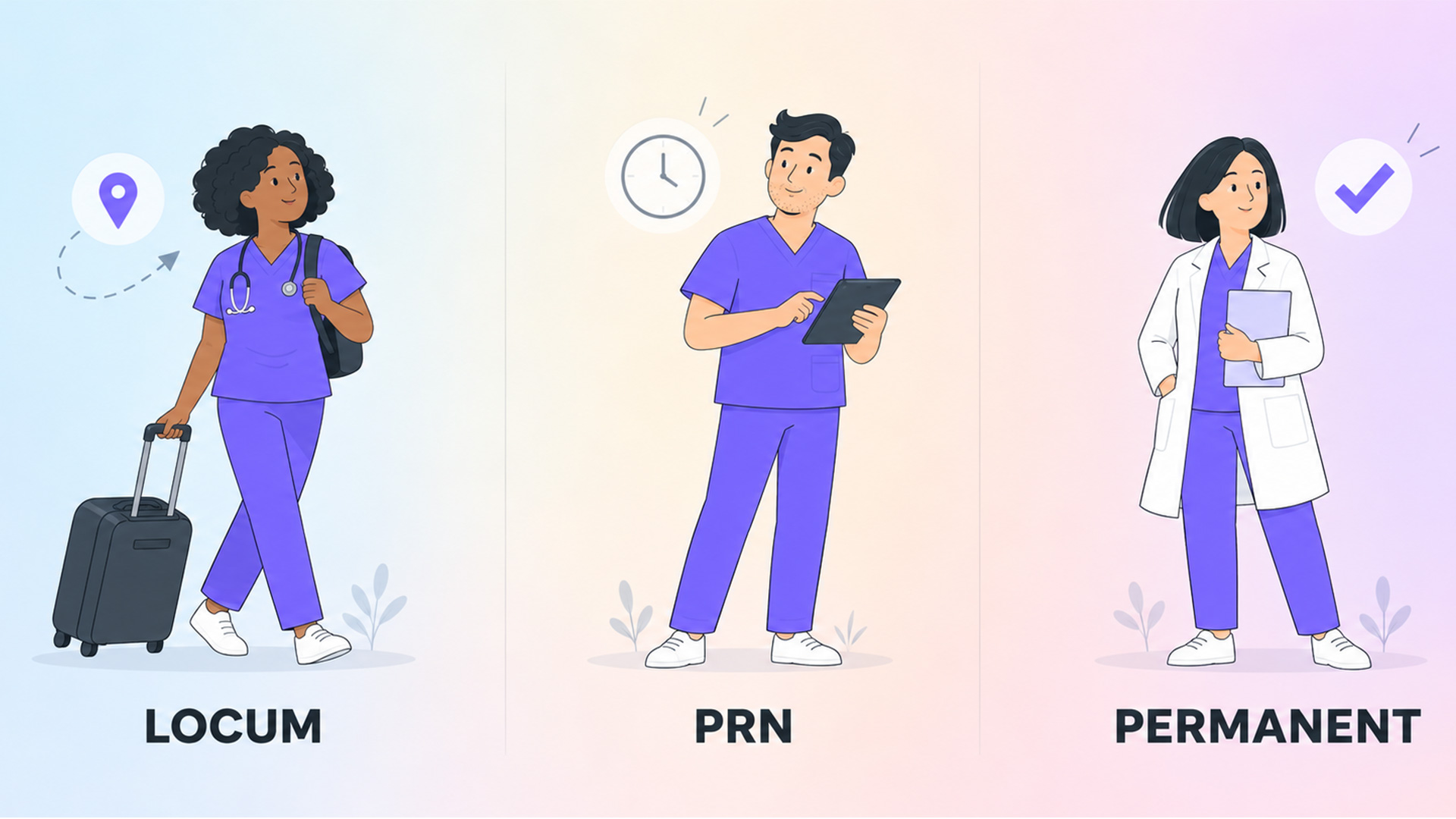
A staffing agency or locum arrangement makes sense for short-term coverage during flu season, planned leave, or an unexpected departure. Direct hire through nurse practitioner recruiting firms fits operators who need permanent NPs across several sites and lack the sourcing capacity to run every search internally. An in-house recruiter works best for large networks hiring continuously, where the volume justifies building local candidate relationships and reporting across facilities.