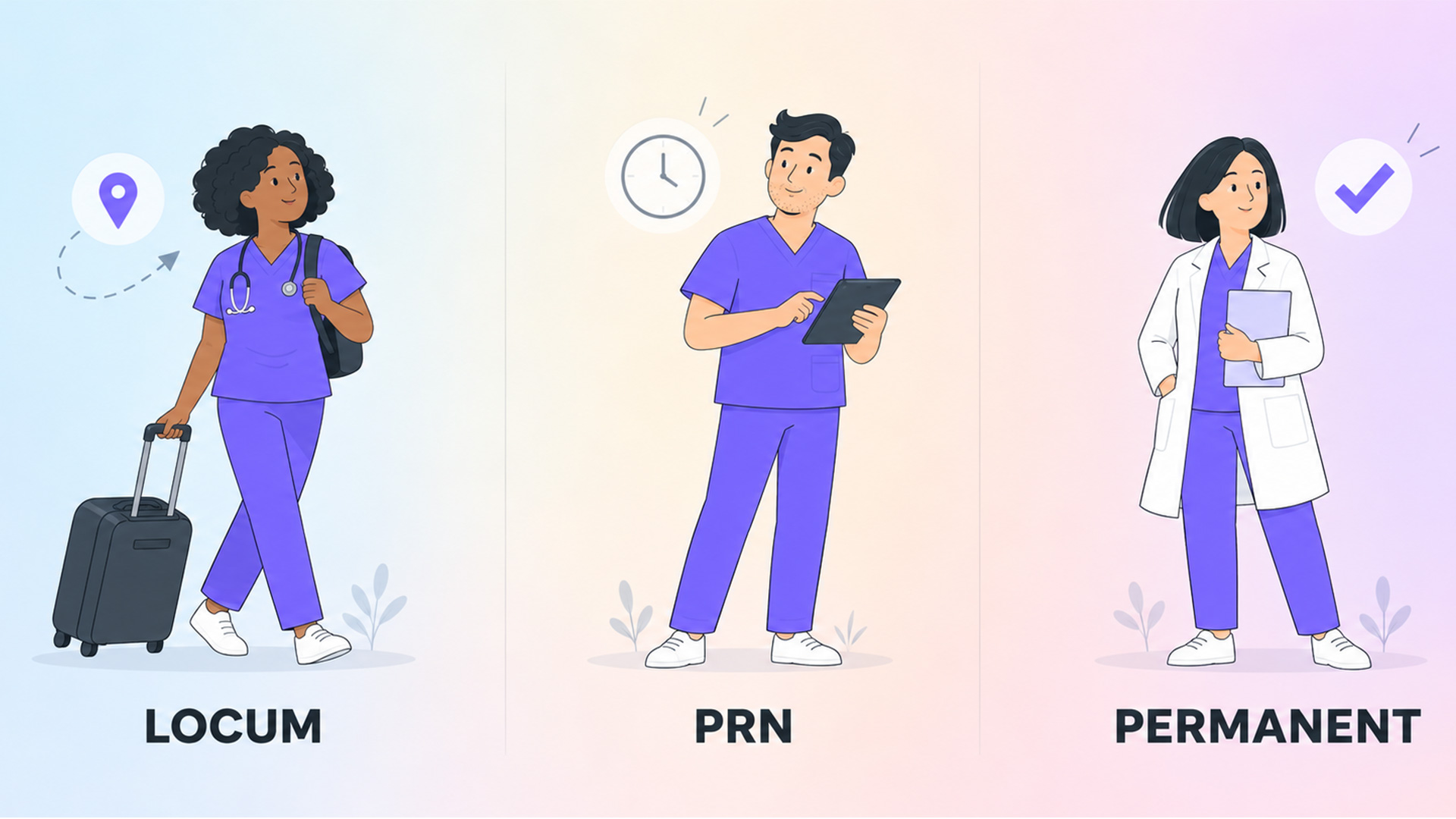


The right NP staffing model depends entirely on the type of gap the organization is trying to close, and choosing the wrong one produces costs that often exceed what the gap itself was generating in the first place. A locum nurse practitioner solves an immediate coverage crisis at a premium price. A PRN nurse practitioner provides flexible support without a long-term commitment. A permanent nurse practitioner placement builds the patient care capacity the practice needs to operate at full clinical productivity. Each model serves a different problem, and treating them as interchangeable versions of the same solution is where most nurse practitioner staffing decisions go wrong.
Why Choosing the Wrong Nurse Practitioner Staffing Model Costs More Than Choosing the Wrong Candidate
Most staffing decisions start with the question of who to hire. The more consequential question is what kind of arrangement to hire into.
A locum nurse practitioner placed into a gap that needed a permanent hire generates a recurring cost that compounds every week the permanent role stays unfilled. A permanent hire brought in to cover a temporary surge creates a long-term financial commitment the organization did not need.
Getting the model right before posting the role is the decision that shapes everything that follows.
The three nurse practitioner staffing models carry fundamentally different cost structures, commitment levels, and use cases. Locum tenens assignment rates typically run two to three times the cost of a comparable permanent hire on an annualized basis. That is justifiable when the need is immediate and temporary. It is difficult to sustain when the vacancy becomes a recurring budget line.
PRN nursing arrangements offer flexibility but create scheduling uncertainty that affects patient care continuity over time. Permanent placement carries an upfront recruiting investment but produces the clinical experience depth, treatment plan continuity, and care team integration that the other two models cannot replicate.
Healthcare organizations that default to one model regardless of the gap type consistently overspend on coverage they did not need or underspend on stability the patient population required. Urgent care centers staffing primarily through locum nurse practitioners pay premium rates for coverage that a permanent hire would have provided at a fraction of the cost. Primary care practices that delay permanent placement in favor of PRN arrangements discover that patient panels do not develop and care continuity erodes faster than the scheduling flexibility was worth.
The decision framework that follows is built around four questions that clarify which model fits the specific gap before the search begins.
What Each NP Staffing Model Actually Is and What Problem It Solves
Each model exists because a different type of staffing problem exists. Understanding what each one was designed to solve makes it easier to recognize when a practice is reaching for the wrong tool.
Locum Nurse Practitioner: High Cost, High Speed, Short Runway
A locum nurse practitioner is a temporary clinician placed through a nurse practitioner staffing agency or locum tenens firm to fill an immediate gap. The arrangement is designed for speed and short-term coverage, not cost efficiency or clinical continuity.
- Locum tenens assignments are typically used to cover unexpected departures, planned leave, sudden patient volume surges, or gaps in acute care, urgent care centers, and behavioral health settings where coverage cannot wait for a permanent hire to clear credentialing
- The cost structure of a locum nurse practitioner engagement includes the clinician’s daily or hourly rate, the staffing agency margin, malpractice coverage, housing and travel allowances in many cases, and credentialing costs, all of which combine to produce an annualized cost significantly higher than a permanent nurse practitioner in the same role
- Locum NPs bring clinical experience across multiple healthcare settings, which makes them effective at stepping into a role quickly without extensive onboarding, but that same mobility means they are not building patient relationships, developing treatment plans with long-term continuity, or integrating into the care team in ways that affect quality of care over time
- Healthcare organizations in high-demand specialty areas including behavioral health, occupational medicine, adult gerontology, and pediatrics often use locum nurse practitioners to maintain patient care access while a permanent search runs, accepting the cost premium as a bridge rather than a solution
- The credentialing process for locum nurse practitioners follows the same general requirements as permanent hires, including state licensure, DEA registration where applicable, and compliance with the medical staff bylaws of the facility, which means the speed advantage of locum staffing applies to scheduling and availability rather than to the administrative timeline that precedes clinical practice
Locum nurse practitioner staffing solves the access problem. It does not solve the stability problem, and organizations that use it as a primary staffing strategy rather than a bridge eventually absorb costs that a different model would have prevented.
PRN Nurse Practitioner: Flexible Coverage Without a Long-Term Commitment
PRN nursing, from the Latin pro re nata meaning as needed, describes a staffing arrangement where a nurse practitioner works on a scheduled or on-call basis without a guaranteed minimum commitment from either party. The model trades continuity for flexibility.
- PRN nurse practitioner arrangements are most effective in settings with genuinely variable patient volume, including urgent care centers, hospitals with fluctuating census, and outpatient clinics with seasonal demand patterns where full-time coverage would create overstaffing during low-volume periods
- The cost of PRN nursing is lower per hour than locum tenens but higher per hour than a comparable permanent position, reflecting the flexibility premium the arrangement provides and the absence of benefits, paid time off, and long-term employment costs the organization does not incur
- PRN nurse practitioners typically hold positions at multiple facilities simultaneously, which means their availability is not guaranteed and scheduling conflicts are a structural feature of the model rather than an exception to manage
- Patient care continuity suffers in settings that rely heavily on PRN nursing because the clinicians rotating through a patient panel are not building the ongoing relationships, chronic condition familiarity, and individualized treatment plans that primary care and behavioral health patients in particular depend on for high quality care
- PRN arrangements work well as a supplement to a core permanent staff rather than as a substitute for it, providing coverage capacity during peak periods, vacations, and unexpected absences without the commitment of an additional full-time hire
PRN nurse practitioner staffing solves the flexibility problem in settings where flexibility is genuinely what the gap requires. In settings where the real need is clinical depth and care continuity, PRN nursing creates a revolving door of experienced clinicians who each deliver competent episodic care without building the patient relationships that drive long-term outcomes.
Permanent Nurse Practitioner: The Model That Builds Rather Than Covers
A permanent nurse practitioner hire is an investment in clinical capacity rather than a solution to an immediate coverage problem. The upfront cost is lower than locum staffing on an annualized basis, the recruiting timeline is longer than either temporary model, and the return on the investment compounds over time in ways that neither locum nor PRN arrangements produce.
- Permanent nurse practitioners develop treatment plans with longitudinal continuity, build patient relationships that drive retention and outcomes in primary care, family practice, behavioral health, and chronic disease management settings, and integrate into the care team in ways that affect how the entire organization functions over time
- The recruiting timeline for a permanent nurse practitioner hire typically runs 30 to 90 days depending on the specialty, the organization’s sourcing infrastructure, and the credentialing requirements of the practice setting, which is longer than locum placement but produces a clinician whose commitment to the role extends beyond the immediate gap
- Permanent nurse practitioners in primary care, adult gerontology, pediatrics, and behavioral health settings typically reach full clinical productivity within three to six months of hire, after which their patient panel, prescribing medications volume, and treatment plan management capacity reflects the full value the position was designed to generate
- Healthcare organizations that maintain a stable permanent nurse practitioner workforce report higher patient satisfaction, stronger chronic condition management outcomes, and lower per-patient care costs than those relying on rotating locum or PRN coverage for the same patient population
- The cost of a failed permanent hire, estimated at 1.5 to 2 times annual salary, is significant but still lower in most cases than the accumulated locum tenens costs the organization would have paid to cover the same position for a full year through temporary staffing
Permanent nurse practitioner placement is the model that addresses the underlying capacity need rather than the surface-level coverage gap, and organizations that delay it in favor of extended locum or PRN arrangements consistently pay more over time than a well-executed permanent search would have required.
The Decision Framework: Matching the NP Staffing Model to the Gap
The three models produce different outcomes because they were built for different problems. The four questions below clarify which model fits the specific gap before the search begins, the posting goes live, or the staffing agency is called.
Four Questions That Point to the Right Nurse Practitioner Staffing Model
Question 1: How long will this gap exist?
Duration is the most direct indicator of which model makes financial sense. A gap measured in days or weeks points toward locum. A gap measured in months with no permanent hire planned points toward a model mismatch that will compound costs over time. A gap that reflects a permanent capacity need the organization has been deferring points directly toward permanent placement regardless of how urgent the immediate pressure feels.
- Locum nurse practitioner arrangements are cost-justified when the gap has a defined end date, including planned leave, a temporary surge in patient volume, or a bridge period while a permanent search runs
- PRN nursing arrangements make sense when the gap is structural but variable, reflecting genuine fluctuation in patient volume or scheduling needs rather than a permanent capacity shortfall
- Permanent nurse practitioner placement makes sense when the gap reflects a sustained patient care need that the organization expects to carry for more than six months, when the specialty requires clinical continuity that rotating coverage cannot provide, or when the cost of continued temporary staffing exceeds what a permanent search would require
Question 2: What does the patient population actually need?
Coverage and continuity are not the same thing. Acute care, urgent care centers, and episodic care settings can absorb rotating coverage without significant impact on patient outcomes because the care model does not depend on longitudinal relationships. Primary care, behavioral health, family practice, adult gerontology, and chronic disease management settings cannot, because the clinical value those settings deliver is built on the NP knowing the patient over time.
- Settings where patients return to the same provider for ongoing treatment plans, medication management, and chronic condition monitoring need a permanent nurse practitioner whose clinical relationship with the patient population is an asset the organization retains
- Settings where patients present with acute, episodic needs that do not require follow-up continuity can absorb locum or PRN coverage without meaningful degradation in care quality or patient experience
- Pediatrics and behavioral health settings occupy a middle position where episodic coverage is possible but continuity produces significantly better outcomes, making the model decision particularly consequential for patient populations in those specialties
Question 3: What is the true weekly cost of the current gap?
Most healthcare organizations calculate staffing model costs by comparing placement fees or daily rates without including the vacancy cost the open position is generating every week it remains unfilled. Including that figure changes the model comparison significantly.
- A primary care or urgent care nurse practitioner position generating conservative estimates of $4,000 to $6,000 per week in lost revenue during a vacancy changes how the cost of a locum tenens assignment at $2,000 to $3,000 per week is evaluated, because the locum cost is partially offset by the revenue the coverage preserves
- A permanent nurse practitioner placement that takes 60 days to complete at a recruiting cost lower than two weeks of locum coverage produces a better total cost outcome than 60 days of locum staffing followed by a permanent hire, which is why the decision to start the permanent search immediately rather than bridge with locum coverage is consequential for the total cost calculation
- PRN nursing arrangements have a lower weekly cost than locum in most cases but produce lower weekly revenue contribution when the PRN NP’s availability is not guaranteed and scheduling gaps result in unfilled patient appointments
Question 4: Does the organization have the infrastructure to support the model it is choosing?
Each model requires different organizational infrastructure to function. Locum nurse practitioner placements require a credentialing process capable of onboarding temporary clinicians efficiently. PRN nursing arrangements require scheduling systems capable of managing variable availability across multiple part-time providers. Permanent nurse practitioner hiring requires a sourcing infrastructure, an onboarding plan, and the physician consultation capacity to support a new hire through the ramp-up period.
- Healthcare organizations without a dedicated credentialing function often discover that locum tenens placements take longer than expected to clear the administrative requirements that precede clinical practice, reducing the speed advantage that justified the cost premium
- Organizations relying on PRN nursing without scheduling systems capable of managing variable availability produce coverage gaps that affect patient access and care team workload in ways that undermine the flexibility the model was supposed to provide
- Permanent nurse practitioner hiring through a done-for-you recruiting service like NPHire removes the sourcing infrastructure requirement from the organization, delivering five specialty-matched, interview-ready nurse practitioners within 30 days from a network of 35,000 NPs built over nine years, so the decision to pursue permanent placement does not depend on the organization having built its own recruiting capability
Choosing the NP Staffing Model Before You Post the Role
The staffing model decision happens before the job description is written, before the staffing agency is called, and before the first candidate is screened. Getting it right at that stage is what determines whether the organization spends the next 90 days solving the gap or compounding it.
Locum nurse practitioner coverage solves the access problem when the timeline is short and the end date is defined. PRN nursing solves the flexibility problem in settings where patient volume genuinely varies and episodic coverage is clinically appropriate. Permanent nurse practitioner placement solves the capacity problem when the organization needs a clinician who is building something, a patient panel, a care team relationship, a treatment plan history, that temporary coverage cannot replicate.
The organizations that consistently make the right call are the ones that answer the four questions before they reach for a solution. How long will this gap exist? What does the patient population need? What is the true weekly cost of leaving it open? Does the organization have the infrastructure to support the model it is choosing? The answers to those four questions point to a model. The model points to a search strategy. The search strategy determines what the next six months look like for the patients, the team, and the budget.
For organizations that have answered those questions and determined that permanent placement is the right model, NPHire delivers five specialty-matched, interview-ready nurse practitioners within 30 days from a network of 35,000 NPs built over nine years across 45 states. Payment happens only when the hire is made. If that hire leaves within six months, the replacement is free.
Frequently Asked Questions
1. What is the difference between locum, PRN nursing, and permanent NP staffing?
Locum nurse practitioner staffing places a temporary clinician through a nurse practitioner staffing agency to cover an immediate gap for a defined period, typically days to weeks. PRN nursing places a nurse practitioner on an as-needed basis without a guaranteed schedule or minimum commitment from either party. Permanent nurse practitioner staffing places a licensed clinician into a long-term employment relationship with the organization. The three models differ on cost structure, commitment level, patient care continuity, and the type of gap each one was designed to close. Treating them as interchangeable versions of the same solution consistently produces either overspending on coverage that was not needed or underinvestment in the stability the patient population required.
2. When does locum nurse practitioner staffing make financial sense?
Locum nurse practitioner staffing makes financial sense when the gap has a defined end date and the weekly cost of the locum arrangement is offset by the patient care revenue the coverage preserves during the vacancy period. Planned leave, temporary patient volume surges, and bridge coverage during a permanent search are the use cases where the locum cost premium is justifiable. The model stops making financial sense when the locum tenens assignment extends beyond its original duration without a permanent hire in progress, because the annualized cost of locum staffing runs two to three times the equivalent permanent hire and compounds every week the arrangement continues without a resolution.
3. What is PRN nursing for nurse practitioners and when should employers use it?
PRN nursing describes an arrangement where a nurse practitioner works on a scheduled or on-call basis without a guaranteed minimum commitment from either party. The model is most appropriate in settings with genuinely variable patient volume, including urgent care centers, hospitals with fluctuating census, and outpatient clinics with seasonal demand patterns where full-time coverage would create overstaffing during low-volume periods. PRN nurse practitioners work most effectively as a supplement to a core permanent staff of experienced nurse practitioners and advanced practice nurses rather than as a substitute for it, providing coverage capacity during peak periods and unexpected absences without requiring the long-term employment commitment of an additional permanent hire.
4. How do locum NP costs compare to permanent nurse practitioner placement costs?
Locum nurse practitioner arrangements typically cost two to three times the annualized equivalent of a permanent hire in the same role, reflecting the agency margin, travel and housing allowances, malpractice coverage, and flexibility premium built into locum tenens assignment rates. A permanent nurse practitioner placement carries an upfront recruiting cost but produces a lower weekly cost from the point of hire forward, making it the more cost effective solution for sustained patient care needs. Healthcare organizations that calculate total staffing cost across a six to twelve month window consistently find that a well-executed permanent search produces a lower total expenditure than an equivalent period of locum coverage, particularly in primary care, behavioral health, and other continuity-dependent settings serving local communities.
5. Can a locum nurse practitioner transition to a permanent role?
A locum nurse practitioner can transition to a permanent role at the same organization, and this pathway is common enough that some healthcare organizations use locum tenens assignments deliberately as an extended working interview before making a permanent offer. The transition requires the same credentialing, privileging, and payer enrollment steps as any permanent hire, and in some cases the locum staffing agency contract includes a conversion fee that the organization pays to hire the clinician permanently. Employers considering this pathway should review the terms of the locum agency agreement before the assignment begins, as conversion fees vary significantly across nurse practitioner staffing agencies and can affect the total cost calculation for the permanent hire. For experienced clinicians whose career goals include building long-term patient relationships and deepening their scope within a specific specialty, the permanent transition often reflects a natural progression from the variety of locum practice toward the stability of a defined clinical home.
6. What are the risks of relying on PRN nurse practitioner staffing long term?
The primary risks of relying on PRN nurse practitioner staffing as a long-term solution are scheduling uncertainty, patient care continuity gaps, and the gradual erosion of the clinical stability that primary care, behavioral health, family practice, and chronic disease management settings depend on. PRN NPs hold positions at multiple facilities simultaneously, which means their availability is not guaranteed and scheduling conflicts are a structural feature of the model. Patient panels do not develop when the clinician seeing a patient changes frequently, treatment plans lose continuity, and the patient relationships that drive retention and outcomes in continuity-dependent specialties require a permanent nurse practitioner whose presence is consistent enough to build on. Healthcare providers in nursing homes, counseling centers, and other settings where patient trust is essential to therapeutic outcomes experience this continuity gap most acutely.
7. How does the permanence of a role affect NP staffing candidate quality?
Permanent nurse practitioner roles attract a different candidate profile than locum or PRN arrangements because they offer the employment stability, benefits, career development opportunities, and patient relationship continuity that experienced clinicians with established practices and long-term career goals are seeking. Professional organizations including the AANP consistently emphasize ethical practices, high standards, and ongoing training as pillars of advanced practice nursing, and the permanent employment model is the one that best supports those commitments by giving clinicians the resources, focus, and organizational support to develop their scope over time. Employers hiring for a role that requires deep clinical integration, long-term patient relationships, and organizational investment should structure the position as permanent from the outset rather than hoping a locum or PRN arrangement produces a candidate with permanent-hire motivations.
8. When does it make sense to run a permanent NP search alongside locum coverage rather than waiting for one to finish before starting the other?
Running a permanent nurse practitioner search in parallel with locum coverage rather than sequentially is the decision that most consistently produces the lowest total staffing cost over a six to twelve month window. Every week the permanent search is delayed while locum coverage runs is a week of premium locum rates the organization pays without reducing the underlying vacancy. Starting the permanent search on the same day the locum arrangement begins means the bridge period, and its associated cost, ends as soon as the permanent hire clears credentialing rather than after an additional 60 to 90 day recruiting timeline that could have been running simultaneously. Healthcare organizations that treat locum coverage and permanent placement as sequential steps rather than parallel tracks consistently spend more on temporary staffing than those that treat them as overlapping phases of the same gap-closure strategy.