

.webp)
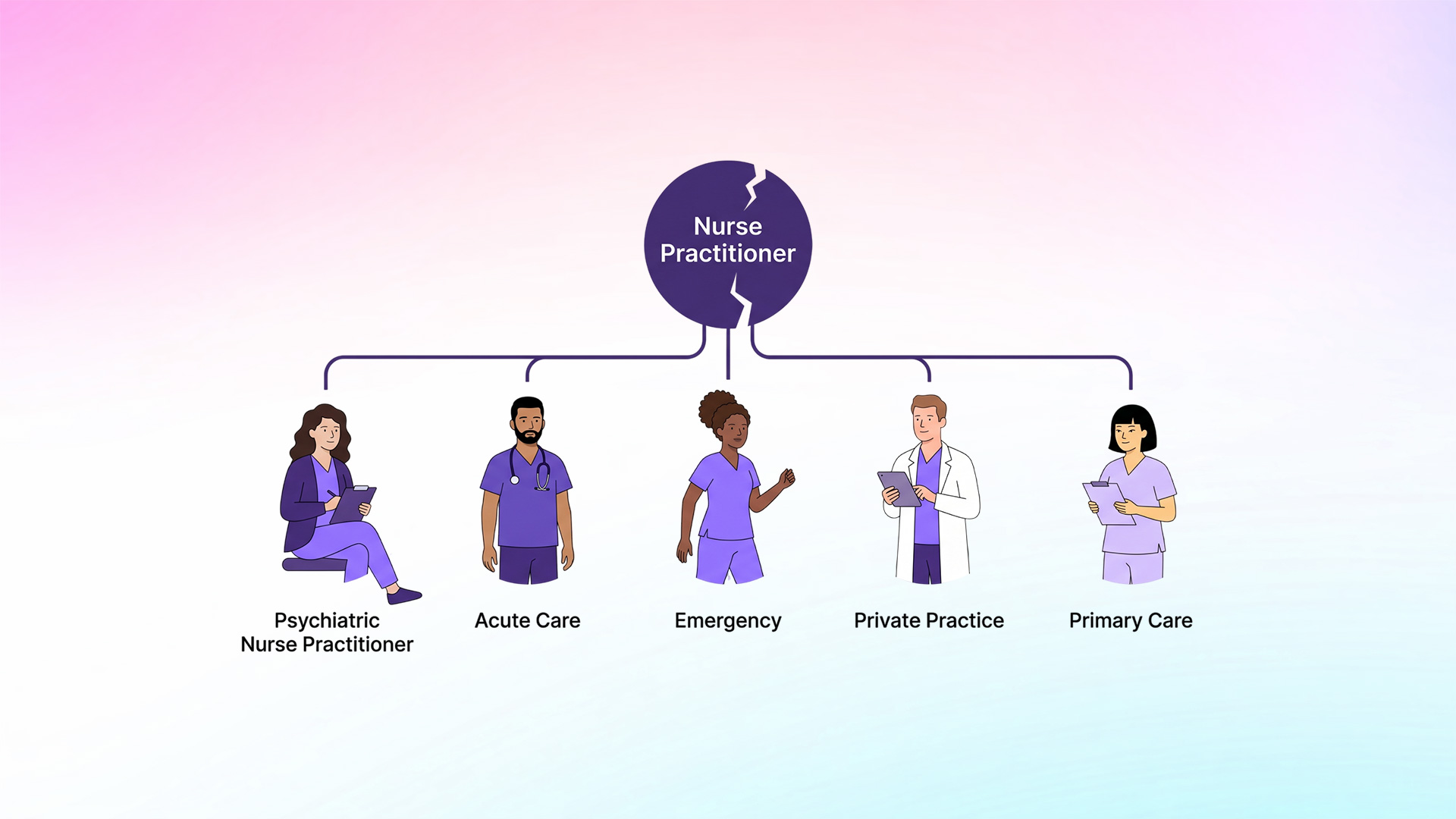
Not all NP roles carry the same clinical demands, patient population, or operational requirements. Treating nurse practitioner jobs as interchangeable across specialties, settings, and scope creates hiring risk that shows up in offer rejections, early turnover, and extended vacancies. Employers that define each NP role by its specific clinical profile, from psychiatric nurse practitioner positions to acute care and private practice, hire faster, retain longer, and build more stable care teams.
How Broad Role Definitions Are Undermining Nurse Practitioner Hiring
Nurse practitioners are filling critical gaps across hospitals, private practice, and community care settings. As demand for NP jobs grows across specialties, the way most employers approach hiring has not kept pace. Organizations continue posting broad requisitions that treat a psychiatric nurse practitioner the same as a clinician managing physical exams in a primary care setting, or a full time acute care provider the same as an NP supporting families in a pediatric clinic.
The operational gap is widening. Employers are competing for a limited pool of certified nurse practitioners across dozens of specialties, yet most hiring workflows still treat the NP role as a single category. When the role definition does not reflect the actual clinical requirements, the entire hiring process builds on a flawed foundation.
The consequences are not limited to recruiting. Misaligned hires affect patients, increase pressure on physicians and care teams, and reduce the stability that hospitals and private practices depend on to maintain consistent care. A job seeker with strong experience in one specialty will disengage quickly when placed into a role built around different clinical expectations, regardless of compensation or benefits.
Healthcare employers that want to reduce hiring risk need to start where the problem actually begins, with how NP roles are defined before a single candidate is ever contacted.
Why One NP Job Title Creates Nurse Practitioner Hiring Problems
The nurse practitioner title covers an enormous range of clinical responsibilities, patient populations, and practice environments. A certified NP managing treatment plans in a psychiatric setting operates in a fundamentally different clinical world than one conducting physical exams in a pediatric or family medicine practice. Acute care, emergency, private practice, and full time hospital roles each carry distinct scope expectations that a single job title cannot accurately represent.
- A psychiatric nurse practitioner managing complex disorders requires a different clinical profile than an NP supporting routine preventive care across ages
- Acute and emergency settings demand experience with high acuity decision-making that primary care NP jobs rarely develop
- Private practice roles often require greater autonomy and reduced physician supervision compared to hospital-based positions
- Compensation bands, schedule expectations, and benefits built around one NP tier create immediate misalignment across specialties
- Generic job postings attract broad candidate volume without filtering for the clinical experience the role actually requires
When employers post a single NP job title without defining the specialty, setting, and scope, they are not describing a role. They are describing a license. The hiring process that follows inherits that ambiguity at every stage, from screening to offer, making it harder to find the right clinician and easier to lose them once hired.
How Generic Screening Criteria Breaks the Hiring Nurse Practitioner Pipeline
When NP jobs are defined broadly, screening criteria follows the same pattern. Recruiters end up reviewing large volumes of applicants who hold the right credentials but lack the specialty experience the role actually demands. A job seeker with years of experience managing treatment plans in a psychiatric setting looks identical on paper to one whose entire career has been built around physical exams in a private practice environment, until the wrong hire is already onboarded.
- Credential review without specialty filtering produces high candidate volume with low role alignment
- Recruiters lose time sorting applicants who meet NP certification requirements but not the clinical profile of the position
- Mismatched candidates advance further into the process than they should, delaying decisions and consuming employer resources
- Specialty-blind pipelines extend time-to-fill without improving the quality of nurse practitioner jobs being filled
- Employers find themselves restarting searches after late-stage offer rejections that better screening would have prevented
The problem compounds quickly. Every week a position stays open, physicians and care teams absorb additional workload, patients experience reduced access, and hospitals and private practices move further from the staffing stability they need. Screening built around a job title instead of a clinical profile does not protect the pipeline. It creates the bottleneck.
Why Misaligned Offers Stall Nurse Practitioner Hiring
Offer stage failures are rarely about compensation alone. When NP roles are not defined with enough specificity upfront, the misalignment that starts in the job posting reaches its most expensive point when a qualified candidate declines. A psychiatric nurse practitioner seeking full time stability in a collaborative care environment will not accept an offer built around a schedule, supervision structure, or compensation tier designed for a different clinical setting entirely.
- Compensation built on a single NP title rather than specialty market benchmarks consistently undershoots what experienced clinicians in high-demand areas expect
- Schedule expectations vary sharply between acute care, emergency, private practice, and community-based NP jobs, and late disclosure increases rejection risk
- Physician supervision requirements differ significantly across states and settings, and candidates discover misalignment late when role definitions are vague
- Employers find that offering strong benefits and security does not recover offers when the core role expectations do not match the clinician's career goals
- Organizations repeat the same search cycle without adjusting the role definition, losing weeks and compounding vacancy costs each time
A job seeker who reaches the offer stage has invested time, and so has the employer. When that investment ends in a declined offer because the role was never clearly defined, the cost is not just financial. It signals a breakdown in how the organization understands the NP specialties it is trying to hire for, and candidates in the same market notice.
How Role-Definition Failures Drive Early NP Turnover
Hiring a nurse practitioner into a misaligned role does not end the problem. It delays it. When the clinical expectations, patient population, or operational structure of a position do not match what the NP was hired to do, disengagement follows quickly. A clinician who built their career managing complex disorders and treatment plans in an acute care setting will not thrive in a role that was described one way during hiring and operates differently on day one.
- NPs hired into roles misaligned with their clinical background and specialty experience disengage faster, regardless of compensation or benefits
- Onboarding gaps surface quickly when specialty assumptions were wrong at hire, placing additional pressure on physicians and care teams to absorb the difference
- Leadership identifies the problem as a performance issue when the root cause is a role definition that never accurately reflected what the position required
- Families, patients, and care teams absorb the instability while the organization restarts a search that could have been avoided with clearer role criteria upfront
- Replacement costs compound the original vacancy cost, and the same generic hiring process produces the same misaligned result
Early turnover is one of the most expensive outcomes in nurse practitioner hiring, and one of the most preventable. When employers invest in defining NP roles with the same precision they expect from the clinicians they hire, the gap between offer acceptance and long term retention closes significantly. The career a nurse practitioner is building deserves a role that was built just as carefully.
The Real Cost of Getting NP Roles Wrong
When nurse practitioner hiring is built around broad role definitions, the consequences reach further than the recruiting team. The operational and financial pressure spreads across care teams, leadership bandwidth, and the patients and families depending on consistent access to care.
- Financial Impact Repeated searches, late-stage offer rejections, and early backfills drive avoidable cost across the hiring cycle. Employers that restart NP searches multiple times for the same position absorb recruiting expenses, temporary coverage costs, and lost revenue from reduced patient throughput. Hospitals and private practices operating with open NP jobs for extended periods face compounding financial pressure that a more precise hiring process would have prevented.
- Workforce Impact Misaligned hires increase burnout risk across the entire care team. When a nurse practitioner is placed into a role that does not match their specialty experience, physicians and nurses absorb the gap. Over time, that additional pressure reduces scheduling flexibility, weakens collaboration, and contributes to broader workforce instability across specialties and settings.
- Patient Access Impact Specialty gaps delay care in the exact settings that needed coverage. Patients seeking support from a psychiatric nurse practitioner, acute care provider, or full time NP in an underserved area experience longer wait times and reduced access when hiring produces the wrong clinical fit. The ability to provide consistent, compassionate care across ages and conditions depends on getting the right NP into the right role.
- Leadership Bandwidth Impact Hiring managers and clinical leaders spend significant time managing fit problems that should never have entered the pipeline. Every misaligned hire that reaches onboarding, struggles through the first months, or exits early pulls leadership attention away from care delivery, workforce planning, and the operational priorities that drive long term organizational stability.
What Higher-Performing Healthcare Hiring Teams Do Differently With NP Roles
Organizations that consistently hire and retain nurse practitioners across specialties are not working with a fundamentally different candidate pool. They are working with a fundamentally different process. The distinction starts before sourcing begins and runs through every stage of the hiring cycle.
What They Do Differently
- Define each NP role by specialty, setting, scope, and supervision structure before a job is posted, ensuring the position reflects what the clinician will actually do on day one
- Build separate screening criteria for each clinical profile, distinguishing between psychiatric nurse practitioner candidates, acute and emergency care providers, private practice NPs, and full time hospital-based positions
- Align compensation to specialty market benchmarks rather than a single NP tier, accounting for differences in schedule demands, patient population, treatment plans, and required experience across np jobs
- Communicate role expectations clearly and early, including physician collaboration structure, supervision requirements by state, schedule details, and benefits, so job seekers can make informed decisions before the offer stage
- Use role-specific pipelines rather than a single NP applicant pool, giving employers find qualified candidates faster and reducing the volume of mismatched applicants consuming recruiter time and resources
What They Measure
- Offer acceptance rate segmented by NP specialty and role type
- Time-to-fill tracked separately across acute care, psychiatric, primary care, and private practice nurse practitioner jobs
- 90-day retention rates by hire source, specialty alignment, and clinical background
- Screening-to-interview conversion by candidate profile match to defined role criteria
- Early turnover patterns that indicate where role definition is still too broad
What They Redesign
- Job requisition templates that capture specialty requirements, patient population, supervision structure, and schedule expectations with enough precision to filter effectively from the start
- Recruiter intake processes that force role differentiation upfront, ensuring hiring managers and recruiters align on the specific NP profile before sourcing begins
- Sourcing channels matched to specific NP practice areas, reaching certified clinicians with relevant specialty experience rather than broadcasting broadly across general nurse practitioner jobs boards
- Onboarding frameworks built around the actual clinical responsibilities of each role, reducing the gap between what NPs were hired to do and what they experience when they join the care team
The organizations seeing the strongest hiring outcomes across NP specialties have stopped treating role definition as an administrative step and started treating it as a strategic one. When the position is built with precision, the right nurse practitioners find it, accept it, and stay. That is not a recruiting advantage. That is an operational one, and it compounds across every hire, every care team, and every patient who depends on consistent access to qualified, experienced clinical support.
Building a Healthcare Hiring Model Around How NP Roles Actually Differ
The nurse practitioner workforce is not a single category, and healthcare hiring systems that treat it as one will continue producing the same results. Misaligned candidates, stalled offers, early turnover, and recurring vacancies are not recruiting failures in isolation. They are symptoms of a hiring model that was never built around how NP roles actually function across hospitals, private practice, acute care, emergency settings, and community-based care.
Employers that invest in role precision before sourcing begins create a hiring process that works with the complexity of the NP workforce rather than against it. A psychiatric nurse practitioner, a full time acute care provider, and an NP managing physical exams and treatment plans in a private practice are not variations of the same hire. They are distinct clinical profiles that require distinct sourcing strategies, screening criteria, compensation structures, and onboarding frameworks.
The financial case is straightforward. Fewer restarts, higher offer acceptance rates, stronger 90-day retention, and less physician and care team disruption all trace back to how clearly an NP role was defined before the first candidate was ever contacted. For hospitals and private practices managing tight schedules, limited resources, and growing patient demand, that precision is not a luxury. It is a baseline operational requirement.
NPHire was built around this reality. The platform gives employers direct access to nurse practitioners across specialties, with the clinical detail and role-specific filtering needed to move from vacancy to the right hire without the inefficiency that generic hiring processes produce. For organizations serious about building stable, high-performing care teams, the work starts with getting the role right.
Frequently Asked Questions
1. Why does treating all NP roles the same increase hiring risk?
Nurse practitioner jobs span a wide range of specialties, settings, and clinical responsibilities that a single job title cannot accurately represent. A psychiatric nurse practitioner managing complex disorders operates under different scope, supervision, and schedule expectations than an NP conducting physical exams in a private practice or providing acute care in a hospital. When employers build hiring processes around a generic NP profile, they attract misaligned candidates, produce weaker offer outcomes, and increase the likelihood of early turnover. Role precision is the foundation of a hiring process that actually works across specialties and care settings.
2. What clinical differences matter most when defining an NP role?
The most important distinctions involve specialty background, patient population, scope of practice, and supervision structure. A full time acute care NP working in an emergency setting requires fundamentally different experience than a certified NP managing treatment plans and chronic disorders in a community clinic. Employers should also account for the ages and complexity of patients the clinician will serve, the level of physician collaboration expected, and whether the role operates within a hospital system, private practice, or independent care environment. These details shape who applies, who accepts, and who stays.
3. How does role misalignment affect NP retention?
When nurse practitioners are hired into roles that do not match their clinical background or career goals, disengagement begins early. A job seeker who built their experience around psychiatric care or acute specialties will struggle to find long term security and satisfaction in a position that was defined too broadly to reflect those expectations. Families and patients absorb the instability when turnover follows, and employers face the full cost of restarting a search that better role definition would have prevented. Retention is a hiring problem before it becomes a workforce problem.
4. What should a specialty-specific NP job requisition include?
A well-defined NP job requisition should clearly state the specialty, patient population, required certifications, supervision structure, schedule expectations, and scope of practice for the state in which the role operates. It should distinguish whether the position is full time or part time, hospital-based or private practice, and whether the NP will work independently or in close collaboration with a physician. Resources, benefits, and compensation should reflect specialty market benchmarks rather than a generic NP tier. The more precisely the role is defined, the more efficiently employers find candidates who are genuinely aligned.
5. How do compensation mismatches happen when hiring nurse practitioners?
Most compensation mismatches occur when employers build salary bands around the NP title rather than the specific demands of the role. A psychiatric nurse practitioner, an acute care provider, and an NP managing physical exams in a primary care setting each operate in different clinical environments with different market rates, and treating them as equivalent creates immediate misalignment. When compensation discussions happen late in the process without reflecting specialty benchmarks, schedule demands, or supervision expectations, offer rejections follow. Employers that align compensation to the actual role rather than the license see stronger offer acceptance rates and fewer late-stage search restarts.
6. What screening changes reduce specialty mismatch in nurse practitioner hiring?
Effective screening starts with criteria built around the specific clinical profile of each NP role rather than general certification requirements. Employers should filter early for specialty experience, relevant patient population, familiarity with required treatment plans, and state-specific supervision compliance. A job seeker with strong acute care experience should be evaluated differently than one whose background is in psychiatric or preventive care, even if both hold the same NP credentials. Separating screening criteria by role type reduces the volume of misaligned applicants and helps recruiters move faster toward candidates who are genuinely qualified for the position.
7. How does role differentiation affect time-to-fill for NP positions?
Organizations that define NP roles with specialty-level precision consistently reduce time-to-fill by narrowing the candidate pool to clinicians who actually fit the position. Generic nurse practitioner jobs postings attract broad volume that requires more screening time, produces more misaligned interviews, and results in more offer rejections, all of which extend the hiring cycle. When employers find candidates through role-specific pipelines and sourcing channels aligned to particular NP specialties, the path from application to accepted offer shortens significantly. Thousands of days of unnecessary vacancy time across hospitals and private practices trace back to role definitions that were never precise enough to filter effectively.
8. What metrics indicate an organization has a role-definition problem in healthcare hiring?
The clearest signals are high offer rejection rates, recurring vacancies in the same NP positions, early turnover within the first 90 days, and low screening-to-interview conversion rates. When employers find themselves restarting searches for the same nurse practitioner jobs repeatedly without changing the role criteria, the definition itself is the problem. Tracking time-to-fill by specialty, retention by clinical background alignment, and candidate drop-off rates by hiring stage gives organizations the data needed to identify where the breakdown is occurring. A well-defined NP role does not just improve hiring speed. It improves every metric that follows.


.webp)